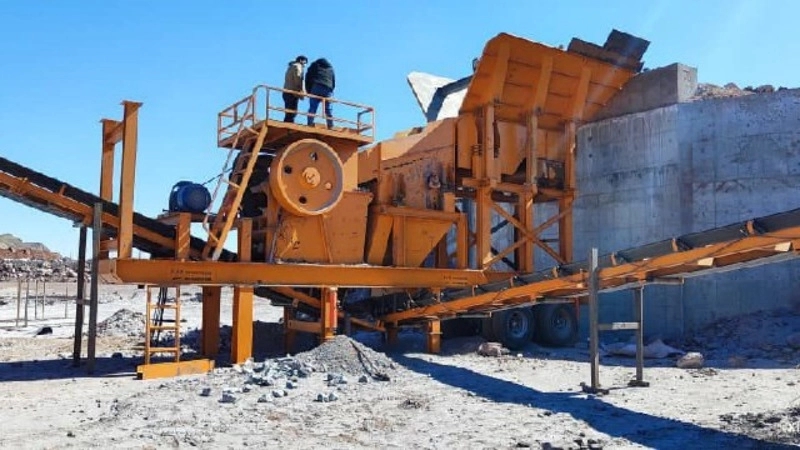
In the bustling world of mining and crushing industries, where thousands of tons of stone are moved per hour, coordination and speed are the first words. Imagine how a production line would function without the presence of transfer devices? We will probably face absolute chaos. These vital equipment are not only responsible for moving materials, but they are considered the lifeblood of a mineral processing plant.
At Razzaq Jahannama Stone Crusher Workshop, we know very well how much the correct selection of this equipment can affect your production efficiency and cost reduction. In this comprehensive article, we will examine the two main pillars of transmission systems, namely conveyor belt and feeder, and explain their key role in increasing the productivity of production lines.
What are transfer devices and why are they important?
When talking about conveying devices, it means a set of mechanical equipment that is responsible for moving raw materials, intermediate and final products in a stone crusher plant. By removing the need for human power for heavy and continuous movements, these devices increase safety and make the production flow uniform.
The quality of construction and engineering design of transmitting devices directly affects the lifespan of other devices. If the feeding of the crusher is not done correctly, the main machine will suffer shock and premature failure. This is the reason that Razzaq Jahannama Stone Crusher Workshop devotes great engineering attention and precision to the production of this equipment.
conveyor belt; The main artery of stone transport between devices
One of the most widely used and well-known conveyor devices in the industry is the conveyor belt or conveyor belt. Without a conveyor belt, it is practically impossible to transfer a huge amount of crushed stones from one stage to another.
Conveyor structure and function
Conveyor belt consists of a resistant rubber or plastic belt that moves on a number of rollers and drums. This system is rotated by a powerful electric motor and gearbox. The main task of the conveyor belt is to transport stone between devices at a constant and controllable speed.
In Razzaq Jahannama Stone Crusher Workshop, the conveyors are made with strong chassis made of studs or beams to be highly resistant to the heavy weight of materials and environmental vibrations. The tires used in these tapes usually have layers that provide excellent tensile strength.
Types of conveyor belts in different sizes and capacities
One of the distinctive features of conveyor belt is its flexibility in design. These devices are designed and produced in different sizes and capacities to meet the specific needs of each project.
- Transverse conveyor belts: are usually produced in widths of 50, 60, 80, 100 and 120 cm. The greater the width of the belt, the higher the capacity to transfer materials per hour.
- Long conveyor belts: They are used to transport materials from the mine to the factory or to store materials at long distances.
- Inclined conveyor belts: They are designed to transport materials to higher heights (for example, feeding the sand or entering the secondary crusher).
The correct selection of the width and length of the conveyor belt should be made based on the input and output tonnage of the production line. Our experts at Razzaq Jahannama Stone Crusher Workshop are ready to suggest the best option in different sizes and capacities according to your needs with expert advice.
Advantages of using standard conveyors
Using a quality conveyor belt produced by reputable manufacturers brings the following benefits:
- Reduction of operating costs: Less energy consumption than moving with a loader or truck.
- Continuity of production: Stone transfer between machines is done without interruption.
- Easy maintenance: Parts such as roller and rubber can be easily replaced.
- Automation capability: The speed of the tape can be adjusted according to the input load. Adjusted.
feeder; Gatekeeper of the production line
The second vital member in the family of transfer devices is the Feeder (Feeder). As its name suggests, the main task of this device is to feed raw materials to the production line. But why is the feeder so important? The answer lies in the phrase uniform feeding of stone to the crusher.
The role of the feeder in the uniform feeding of stone to the crusher
Stone crushers, especially jaw crushers (primary), need a continuous and uniform flow of stone for optimal performance. If the input load is entered suddenly and massively (the so-called choking of the device), there is a possibility of stone jamming, breaking the shoulders and even burning the engine. On the contrary, if the load is low, the device will work and energy will be wasted.
Feeder is placed at the beginning of the line and below the storage silos, it directs the material into the crusher with a set track. This uniform feeding of stone to the crusher makes the output product have a more uniform granulation and increases the overall efficiency of the line. Razzaq Jahannama stone crusher workshop designs different types of feeders for different working conditions.
Types of feeders: vibrating or connecting rod
In general, feeders are classified into two main types: Feeder (vibrating or connecting rod). The choice between these two models depends on the type of stone, humidity and its dimensions.
1. Vibrating Feeder
This type of feeder creates a strong vibration in the device tray by using vibration motors or crank shafts. This vibration causes the stones to move forward and fall into the crusher.
- Advantages: Less wear and tear of moving parts, the ability to separate soil and gravel (in Grizzly models), suitable for dry stones.
- Use: It is mostly used to feed jaw crushers and cubits. Grizzly models have screens that separate the soil before entering the crusher, which is a factor to prevent wear and tear of the devices.
2. Reciprocating Feeder
This feeder, which is also known as a mountain feeder, pushes the stones forward with the reciprocating movement of a tray or plate (by crank and connecting rod system).
- Advantages: Very high power to bear very large and heavy stones, suitable for wet and sticky stones that get stuck in the vibrating feeder.
- Application: In mines that have large stones (boulders) or raw materials with high humidity, the rod feeder is the best option.
Preventing the depreciation of devices by using a suitable feeder
One of the most important functions of the feeder is preventing the depreciation of devices. How?
When stones enter the crusher in a controlled manner, shocks are reduced. Also, by using grizzly feeders that separate the soil, the entry of soft and abrasive materials into the crushing chamber is prevented. Dirt and sand cause rapid corrosion of jaws and hammers. Therefore, investing in a quality feeder from Razzaq Jahannama Crusher Workshop is actually an investment for the lifetime of your entire production line.
Why Razak Jahanma transfer devices?
In today's competitive market, build quality makes the difference. Conveying devices produced in Razak Jahannama crusher workshop have unique features:
- Precise engineering design: All conveyors and feeders are designed based on accurate dynamic calculations to have the least vibration and the most efficiency.
- Use of first-class materials: Use of wear-resistant alloy steels in the body of the feeders and the use of the best type of rubber and rollers in the conveyors.
- Product variety: Presentation Products in different sizes and capacities according to customer needs. Whether you are a small sand mine or a large iron ore processing complex, we have a solution for you.
- Warranty and after-sales service: We believe in the quality of our products and by providing strong after-sales service, we give you peace of mind about the supply of parts and repairs.
Key points in the maintenance of transmission devices
In order for your conveying devices, both conveyor belt and feeder (vibrating or connecting rod) to have a longer life, it is necessary to observe the following points:
- Daily inspection of rollers: Stuck rollers cause rapid wear of the conveyor belt.
- Adjustment of belt tension: Too loose or too tight of the belt can damage the motor or the belt itself.
- Regular lubrication: Feeder and conveyor bearings should be greased periodically.
- Feeder spring control: In vibrating feeders, the health of the springs is vital for the correct operation of the machine.
- Cleaning: Accumulation of materials under the conveyor belt or around the feeder springs can disrupt their performance.
The impact of transfer devices on SEO and productivity of mining site
You might be surprised, but physical order in mining is not unlike digital order in SEO. Just as conveyors facilitate the flow of material, a good content structure guides the flow of users through the site. At Razaq Jahannama Stone Crusher Workshop, we use the same precision in making feeders for uniform feeding of stones to crushers, in providing technical information to customers. Our goal is transparency and awareness so that you can make the best choice.
conclusion
Conveyors are the main foundation of a mineral processing line. The correct choice of conveyor belt for stone transfer between machines as well as the correct choice of feeder (vibrating or connecting rod) for uniform feeding of stone to the crusher makes the difference between a profitable production line and a costly production line. These equipments preserve your capital by preventing the depreciation of the main devices.
Razzaq Jahannama Stone Crusher Workshop with years of experience in designing and manufacturing all kinds of mining machines, is proud to offer the best conveying devices in different sizes and capacities to dear artisans. For a free consultation and price inquiry, contact our technical experts today and experience the distinctive quality. We are with you so that the wheel of the country's mining industry turns with more power.